
No Starry Stonewort (SSW) was found in Lake Augusta during an “Aquatic Invasive Species Early Detection Survey” conducted on August 25, 2026 by LimnoPro Aquatic Science.
Starry Stonewort (SSW) was first discovered in Minnesota in August, 2015 in Lake Koronis (near Paynesville, MN). It has also been found in a couple lakes in our area including: Lake Sylvia & Pleasant Lake. Luckily, those lakes have found it early and are aggressively treating it (within DNR Guidelines).
SSW found in Clearwater Lake in 2023
SSW was found in Clearwater Lake in August 2023, during a routine Point Intercept Survey. It is currenty located along south shore in East Basin, covering ~1.8 acres. This area is clearly marked by 14 Floating Signs. Please STAY AWAY from that area.
Clearwater Lake Property Owners Association (CLPO) is working with Blue Water Science, MN DNR, Clearwater River Watershed District (CRWD) and Lake Restoration to manage this SSW infestation. Please go to the Clearwater Lake Property Owners Association (CLPO) for the most up to date information: https://clpo.org.
Lake Augusta Association does annual surveys in late summer looking specifically for SSW In Lake Augusta. This survey is done by Limnopro Aquatic Services. Late summer is when SSW is easiest to identify. If you believe you have identified SSW in Lake Augusta or Clearwater Lake in a new location , please contact any LAA Board Member immediately.
Starry Stonewort Information
Appearance
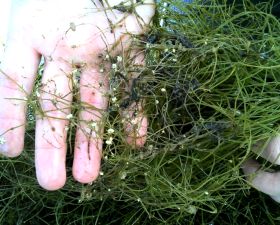
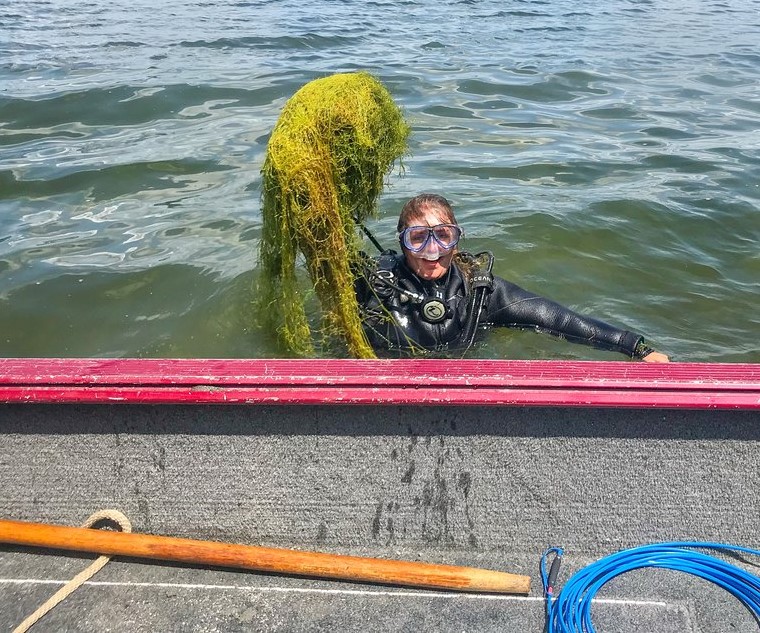
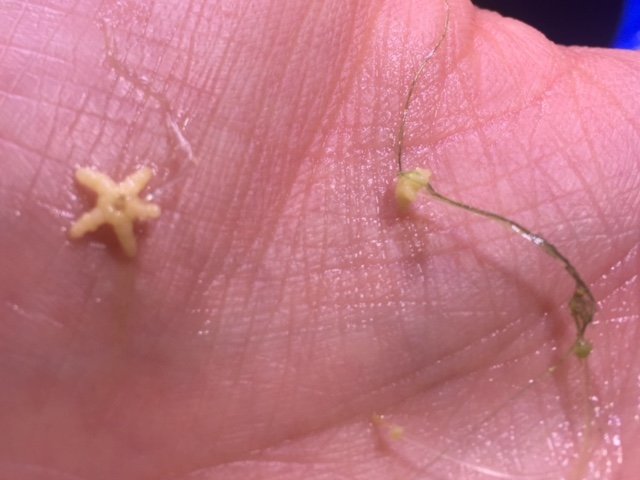
Starry stonewort is a bushy, bright green macro-algae. It produces a characteristic star-shaped bulbil.
Leaves and Stem
Thin, bright green branchlets (branch-like structures) can be variable in length and are arranged in whorls (radiating out from a single point) around the stem. Branchlets typically extend in acute angles away from the stem nodes.
Reproductive Structures
White, star-shaped bulbils (asexual reproductive structures) the size of a grain of rice form on clear threads at the base of the plant and may be found at or below the sediment surface. Small, orange spheres called antheridia (male reproductive structures) may be visible near the tips of the branchlets.
Biology
Starry stonewort is a macro-algae, meaning it does not have a vascular system like true plants. Each branchlet or stem is a single cell. Native populations consist of both males and females, but all known introduced populations in North America are male. Bulbils are present throughout the growing season, but become most obvious and plentiful in late summer. Starry stonewort may form a dense carpet of material in shallow areas.
Origin and Spread
Starry stonewort is native to Eurasia, from the west coast of Europe to Japan. The species was unintentionally introduced into the United States’ Great Lakes through the discharge of contaminated cargo ship ballast water. The first occurrence in the United States was in 1978 along the St. Lawrence River. It was first confirmed in Minnesota in August 2015, in Lake Koronis and connected Mud Lake (Stearns County). Only 13 lakes in Minnesota are listed as infested with starry stonewort. Refer to the infested waters list for current distribution.